

An email went wildly viral within Tencent today, a thank you letter from a blind man to Ma Huateng.
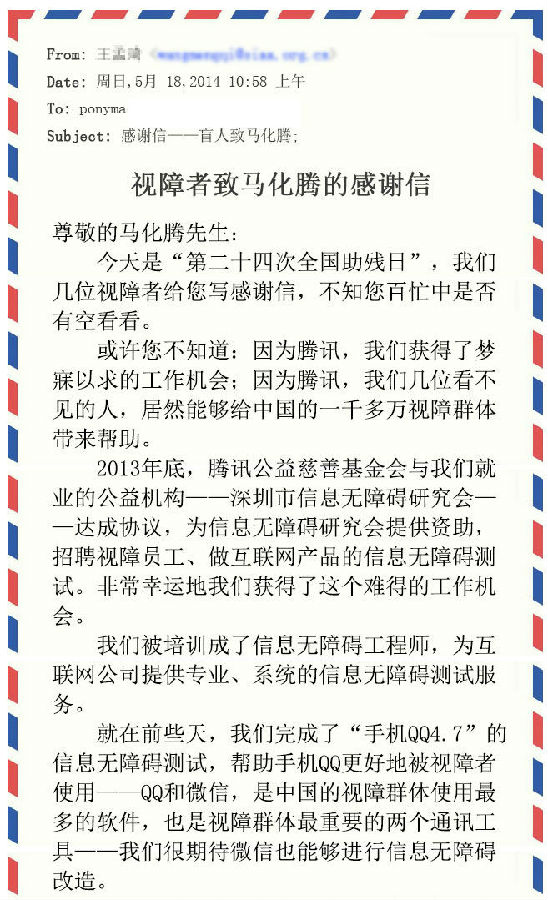
In Tencent, there is such a group of technical men, harboring a big dream of public welfare, making continuous efforts for product accessibility transformation. The email refers to the "Internet Product Accessibility Transformation" project jointly created by the Tencent Public Welfare Foundation and the Tencent Volunteer Association Accessibility Branch.
Xiaoteng was lucky enough to have a face-to-face conversation with stone (Mr. Huang Xitong mentioned in the email), Mr. Huang, the president of Tencent Volunteer Association's Accessibility Sub-committee. He has the same low-key, modest, and occasionally wry smile as other engineers, but is extraordinarily solemn when he tells stories about his work with blind users. Let the technology better serve the public good, so that more people pay attention to and support accessibility.
The cause of accessible product remodeling
Sister Teng: What was the opportunity that made the company start to do accessibility product remodeling?
Stone: It was a Saturday noon in 2009, the first time I came to the Shenzhen Library, as soon as I entered the door, I noticed the "barrier-free reading room", and what caught my eye was a computer. My first thought was: "How can a blind person use a computer? Can they use our products?" I asked a few blind people. I asked a few of my blind friends, but I was sorry to find out that they couldn't use the products we had developed with such great care. I was shocked and frustrated, and I thought to myself that I must do something substantial for the accessibility transformation of Tencent's products through myself and my colleagues.
At Tencent, we have achieved one milestone after another on the road to product accessibility transformation.
Xiaoteng: I learned that QQ mailbox was the first product to be tested for accessibility transformation, based on this library "encounter"?
Stone: Yes, I came back and had an internal discussion with my mailbox colleagues. The engineer in charge of development came up with a creative, temporary solution that solved the problem of visually impaired users within a day and went live quickly. The development GGs were very low-key and didn't publicize this change in the company. However, this small matter spread among the blind community, and a series of cross-product information accessibility transformation actions sprang up within Tencent. The company has also launched a series of cross-product information accessibility initiatives within Tencent, such as QQ on the PC, HandQ, Qzone, QQ Music, Tencent.com, Weibo, and so on.
China Information Accessibility Products Alliance was founded to "give back the rights of blind users"
Xiaoteng: It's not enough for Tencent to be the only company to provide barrier-free product modifications, so I also learned that Tencent later took the lead in establishing the "China Information Accessibility Products Alliance", so Mr. Huang briefly told us about this story. And what was Tencent's role in it?
Stone: The "China Information Accessibility Products Alliance" has been in the works since 2012, and on November 11, 2013, the day of Tencent's anniversary, Tencent, Alibaba, Baidu, Microsoft China, W3C, and the Shenzhen Information Accessibility Research Association all sent representatives to gather in Shenzhen for the "China Information Accessibility Products Alliance" conference. The "China Information Accessibility Products Alliance" was established. The "Information Accessibility Product Alliance" is also making continuous efforts for product accessibility transformation. We want to return the rights of blind users to them.
Speaking of Tencent's role, first of all, as China's largest Internet, Tencent has the longest product line covering every aspect of our online life, so Tencent's primary responsibility in the accessibility cause is to start from me and work hard to do a good job in the information accessibility of our various products. Tencent volunteers set up a technical public service team last year, and one of the most important projects is to promote the information accessibility transformation of various products.Second, we are also fully aware that people with disabilities do not just need the services provided by Tencent, they need a complete Internet that is accessible to companies of all sizes. Therefore, Tencent spares no effort in promoting the development of the Information Accessibility Products Alliance, including funding from the Tencent Public Welfare and Charity Foundation for the Alliance's innovative accessibility promotion work, and attracting more companies to join through the influence of the Alliance to promote the accessibility transformation of various Alliance members.
Third, we also see that accessibility requires a set of effective standards and guidelines. Through our collaboration with the W3C on information accessibility related technical standards, we are able to raise the voice of China on behalf of the blind and Chinese developers, and promote the evolution of related international standards, as well as collaborate with the Academy of Telecommunication Research of the Ministry of Industry and Information Technology (MIIT) to study how to formulate next-generation China's information accessibility standards and specifications.
Establish a value that "accessibility is the default option for Internet products" without discriminating against any user.
Xiaoteng: What do you think is the motivation and significance of making accessibility changes for a relatively small group of people?
Stone: The key to accessibility is "no", which means that engineers don't create barriers, rather than creating barriers and then doing a public service project to remove them. We are now in a social environment with too many barriers, we can only use the public welfare attitude to promote, but in the long run, I hope that we can establish a "accessibility is the default option for Internet products" values, like we build a blind sidewalk for the sidewalks, is not a special public welfare project, but a standard equipment. The products we make should not discriminate against any user.