

一个新型社会企业意识的启用
时间:2011-02-14
A sense of enablement
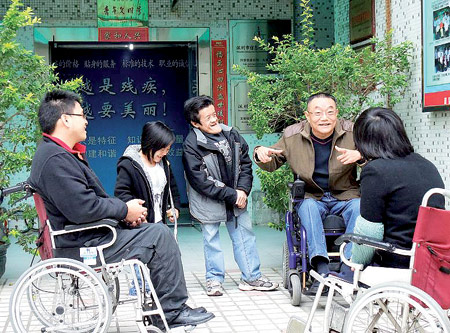
Zhang Weining's company helps disabled people make their own way.Photo: Courstesy of Zhang Weining By Teddy Ng
At first glance, Zheng Weining does not look like someone whose aim in life is to change social attitudes.
Zheng suffers from hemophilia, a genetic disorder that hampers the body's ability to control blood clotting and stop bleeding when a blood vessel is broken. It also keeps him permanently confined to a wheelchair.
But that does not mean that the 56-year-old is without a voice. Together with four friends who suffer from other disabilities, Zheng has established a company that does Web page design, software development and animation in Shenzhen, South China's Guangdong Province, which employs about 1,200 people.
The company, Shenzhen Canyou Group, mainly hires disabled people, as its mission is not only to make profits, but also to use these profits to help disabled people better integrate into society. The name of the company, Canyou, means "friends of the disabled."
The benefits of working for the company are abundant: It provides accommodation, hires other staff to do the laundry and cooking, pays for medical insurance, and offers lifelong employment with the promise of a pension.
"We are making a profit in order to maintain our way of life," Zheng said. "It is not necessary to make profits if we don't take full care of the disabled."
Zheng says many disabled people see themselves as a burden on their family and society because people are reluctant to hire them. Many just stay at home all day, feeling hopeless and finding no meaning in life.
Zheng saw things the same way before setting up Canyou in 1999.
Born with the genetic disorder, Zheng could not walk until he was 13, when advances in medical technology allowed him to do so with a stick.
When he was 20, he managed to get a job at a factory, where he met Zhang Chunzhen, a healthy woman who would later be his wife. After working for a few years, a deterioration in his health forced Zheng to quit.
Zheng stayed at home most of the time, venturing out only to go to hospital each week for blood transfusions and medical checks that cost his family about 150,000 yuan ($22,749) a year.
Turning point
Zheng managed to complete three degrees in Chinese language, law and economics through distance learning between 1982 and 1991. Despite that achievement, Zheng was still turned down by employers who believed he was unfit to work because of his health.
Thinking his family would be relieved if he died, he made three suicide attempts.
"For the last suicide attempt in 1998, I tried to climb over the balcony, but I was too weak to do it and my wife pulled me back," Zheng said.
Zheng's mother died a year later and left him 300,000 yuan. His mother's death proved to be a turning point in Zheng's life.
"That was her life savings, and I would have been ashamed if I wasted the money doing nothing," he said. "I started thinking about doing something meaningful with the money."
Joining forces with his four disabled friends, he established a website listing all the information that may be useful for people like him."
I just thought at that time I should do something else. Even if I wanted to die, it would not be too late if I had spent all the money and made no achievement," he said.
The website did not make any money until 2000, when it earned 60 yuan for helping a client type a document.
After that, Zheng and his friends promoted Web page design services on the website. The first job could hardly be described a success, after the client failed to pay the 800 yuan as promised.
"We were frustrated that time, but I also believed that we could earn 800,000 yuan in the future because we had learned a lesson from losing the 800 yuan," Zheng said.
Slow success
In order to attract customers who were prejudiced against disabled people, Zheng decided to lower his prices. The company built up more clients over the years, and expanded the business to include animation and software development. The biggest job conducted last year was worth 6 million yuan.
The reason Canyou chose to focus on information technology is not only because there is a high demand for the service, but also because it is a job that suits the disabled."
With the Internet, we can just sit down and do our jobs. This is the only way for us to survive. We do not have any other choice," he said.
"Some disabled people cannot wash clothes, go to the market to buy vegetables or even take a bus. The company will cater to such needs, and if those are all taken care of, the disabled people will patiently sit in front of a computer and do their jobs."
"This is the only way for us to gain recognition."
A helping hand
From time to time, disabled people across the nation will come to Zheng for a job. Zheng will hire them once they are qualified - a science degree in software development and a diploma in animation. If the employee is paralyzed, Zheng will assign him or her to e-commerce work, using the computer while lying on a bed.
When workers are forced to retire because of health problems, the company will still pay their salaries and accommodate them in the hostel regardless of how long they have worked.
While that may sound like Zheng is encouraging laziness, there are only four people aged 40 or above from his company who are retired.
"The disabled are well aware of the desperate feeling of doing nothing all day. They would not choose to live such a life unless they are really forced to do so," he said.
Indeed, many are willing to work overtime. "We want to live our own lives. This is what we want," he said.
Zhang ever decided not to leave his money to his wife and daughter. In 2009, he established the Zheng Weining Charitable Foundation, transferring his shares in the company to the foundation.
However, he said he is determined to protect the interests of the disabled. When he and Liu Haijun, Zheng's companion, were refused permission to board a Shenzhen Airlines flight in Beijing last year, Zheng was furious and took the company to court, demanding more than 12 million yuan in compensation.
The airline said the two would not have been able to escape if the airplane encountered an emergency situation, but Zheng did not accept the explanation.
"This is a backward form of treatment against the disabled, which should not be tolerated," Zheng said.
He has reached a settlement with the company, and details will be released soon.